

Would you bet on the apocalypse?
It's only $0.99

Did you know that for the low price of $0.99, you can bet on whether or not global carbon dioxide emissions will exceed 39,000 million metric tons by the end of the year?
Or, if you’re looking for a quicker hit of dopamine, whether the highest temperature in Los Angeles will exceed 84 degrees today?
We have reached a bizarre stage in the lifecycle of capitalism where we are no longer merely ignoring the slow-motion collapse of our planet; we have found a new way to monetize it.... by betting on it.
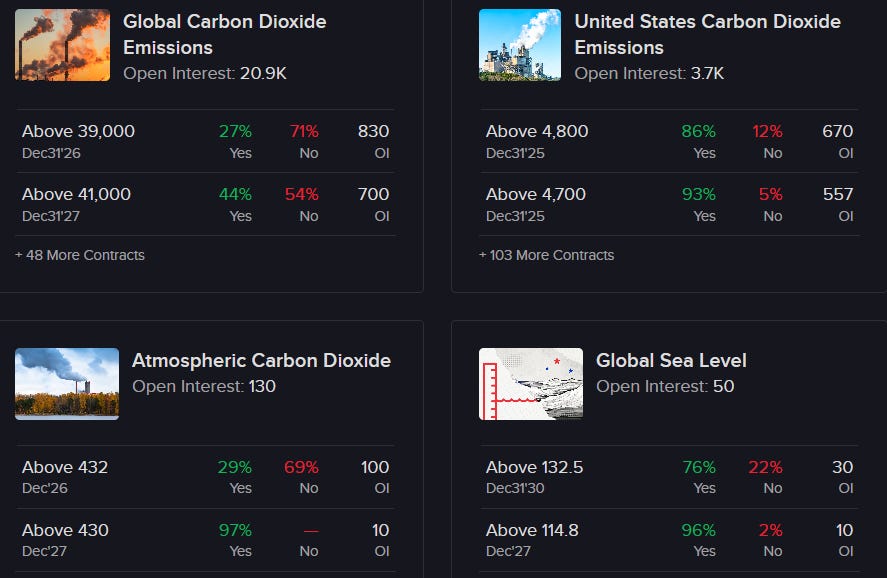
We have successfully engineered the financial instruments required to day-trade the apocalypse.
A round of applause for humanity, please.
You might wonder how a society arrives at a place this deeply detached from its own survival...
How do you get people to accept a financial system that bets on their own destruction?
Simple. To keep a market like this running, you need a populace that is too numb, too isolated, and too inundated with urgency to notice the smoke coming under the door. And that system was built, piece by piece, by the modern marketing and tech industry.
For as long as human beings have had things to trade, marketing was simply a function of gravity. You built a reliable tool, people used it, and they told their neighbors. If you made a flimsy tool, it broke, and you went out of business. The market was grounded in actual utility and genuine human need.
But eventually, the people selling the tools realized that waiting for organic demand wasn’t quite profitable enough. So they stopped waiting for demand and started engineering it.
Today, we don’t rely on the quality of a product to make a sale; we just beat you over the head with the sheer volume of the pitch. We expose you to thousands of hyper-targeted ads a day, spending hundreds of billions of dollars to weaponize your insecurities, hijack your paleolithic emotions, and manufacture artificial FOMO just to get you to buy profoundly mediocre products.
But if you are going to subject a population to that level of relentless bombardment, you first have to make sure they can’t look away. You have to build a room that they never want to leave.
So the modern marketing and technology industries got together and built the ultimate delivery mechanism: social media.
Contrary to what the name implies, social media wasn’t actually designed to connect you; quite the opposite, its goal was to enclose you. And to keep you inside this ecosystem, we didn’t need to use force; we just used your own biology. We took your deepest, most primal vulnerabilities and we quantified them.
We took human approval and turned it into hearts and thumbs up.
It is incredibly difficult to sustain a meaningful, collective panic about the ecological collapse of the planet when your nervous system is constantly being hijacked by Tinder match notifications, Instagram DMs, or whatever breaking news is happening at each nanosecond.
You can’t worry about doomsday when you are mentally incapable of focusing on it.
When you widen the lens and look at the bedrock of our market system, you see a global economy built entirely on the model of self-interest. It relies on the unquestioned, almost religious faith that consumer desire is limitless and deeply narcissistic.
But the fatal flaw in this model is that we are running an algorithm of infinite growth on a highly finite rock - the Earth.
When we treat both human attention and the earth’s physical resources as endless dumping grounds, we train ourselves to never think about what happens after the purchase.
We are conditioned to ignore the physical reality of our consumption, completely blinding ourselves to the environmental and social byproducts of all that sourcing, production, and distribution.
We abstracted the damage so thoroughly that the destruction of our own planet barely even registers. Until we eventually end up betting on our own demise, apparently...
Marketers sell an ideology. We sell the deeply comforting, highly profitable illusions that:
Human consumption operates in a guiltless vacuum.
Your desirability is directly proportional to the number of Rolex watches you own.
Someone else will eventually fix the consequences of our actions.
For the last twenty years, the absolute governing law of the internet has been to remove all barriers between a human impulse and a financial transaction. To what end?
Can we look at a marketing dashboard and actively choose a 2% conversion rate that comes from treating a person with genuine dignity, rather than squeezing out a 5% conversion rate through coercion? Can we stop tracking them when they leave our ecosystem? Can we stop pretending that a human being’s value is defined by their lifetime revenue potential?
Can we really put the genie back in the bottle?
The only way to take this machinery apart is by fundamentally changing our relationship with the consumer and treating their attention and intention as something sacred. And for the first time in a long time, actually look at what we are selling, who we are selling it to, and what the consequences of that sale are.
Even Philip Kotler (the father of modern marketing) is now telling the industry to dial it back and focus on “sensible consumption,” and de-consumption as a necessary response to the climate emergency we’re now facing.
This is the crossroads. On one hand, you have the path of “sensible consumption,” which requires the heretical choice of introducing friction in the sales process. On the other hand, you have the reality of today.
And until we bridge that gap, we are all just sitting in the living room, swiping our screens, waiting to see if our 99-cent bet on the apocalypse finally pays out.